2890 Malaspina Promenade
Updated: Aug 5
The Oldest House Currently on the Island
By Sherwood Inglis

In the 1870’s, under the BC Homestead Act, Savary Island was divided into five District Lots — DL1372, 1373, 1375, 1376 and 1377 (for whatever reason, there does not appear to be a DL1374).
In 1888, Jack Green preempted the 160 acres of DL1372, located at the eastern end of Savary. Between 1888 and 1891 he also preempted the 317 acre DL1375 at mid-island and DL1377 at the western end. And on October 3, 1893, he applied to preempt DL 1373, which lay between his already acquired District Lots. Had he been successful in this last application, he would have owned four of the five District Lots on Savary. Unfortunately for Jack Green, that last application was abruptly terminated, as he was murdered on Savary in October 1893, 24 days after his application was filed.
John Fogg had been the first to try to acquire DL1373. He applied in 1890, but he was unable to fulfill the requirements, and the property reverted to the Crown.
The third attempt to acquire DL1373, and the first successful one, was made by Swedish logger Lewis Nathaniel Anderson. He began the procedure to acquire DL1373 on August 25, 1899. Anderson worked as a timber cruiser for the Hastings Sawmill in Vancouver, then made his way up the coast where he worked in the Palmer logging camps around Theodosia Arm. He married Lulu Irene Palmer, the sister of Bill Palmer.
Jack Green had died intestate and without heirs. It took until 1909 for his estate to be sorted and finalized, at which time his property was put on the market.
Having satisfied the BC Government Property Preemption requirements, including paying the purchase price of one dollar per acre, on Sept 17, 1909, Lewis (Louie) Anderson became the owner of the 151 acres of DL1373. This acreage commences some 150 yards west of the wharf, extends across the island to the south side, and then proceeds west to just short of First Point.
Minnesotan timber merchant Harry Leroy Jenkins purchased the remaining district lots for logging, also in 1909.
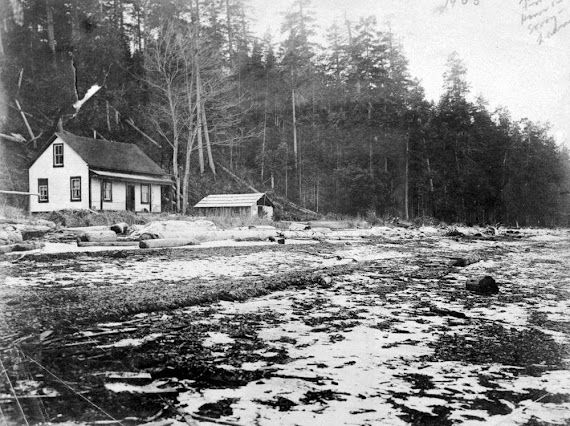
First known photo of the Anderson cabin dated 1908
In 1905, Anderson had built a cabin on the northern shore of DL1373, about 200 yards west of the current wharf site. That primitive cabin — now 2890 Malaspina Promenade — sat all alone, on 151 acres of Savary property! He and Irene already had three children, Jimmy (1903), Andre (Andy) (1904) and Terry (1905), and two more were born in the cabin in the following years — Sylvia (1907), and Pearl (1910). Pearl was the mother of Ansel Aho, a well-known and popular Savary personality in later years. Pearl's ashes now rest on the hill behind the cabin. A well-preserved child's shoe was discovered under the cabin. Might it be Sylvia’s shoe?

Sometime later in 1909, Lewis Anderson sold DL1373 to Harry Leroy Jenkins, who now owned all of Savary’s District Lots, the entire island. Anderson remained in the home he had built and acted as caretaker for Jenkins.
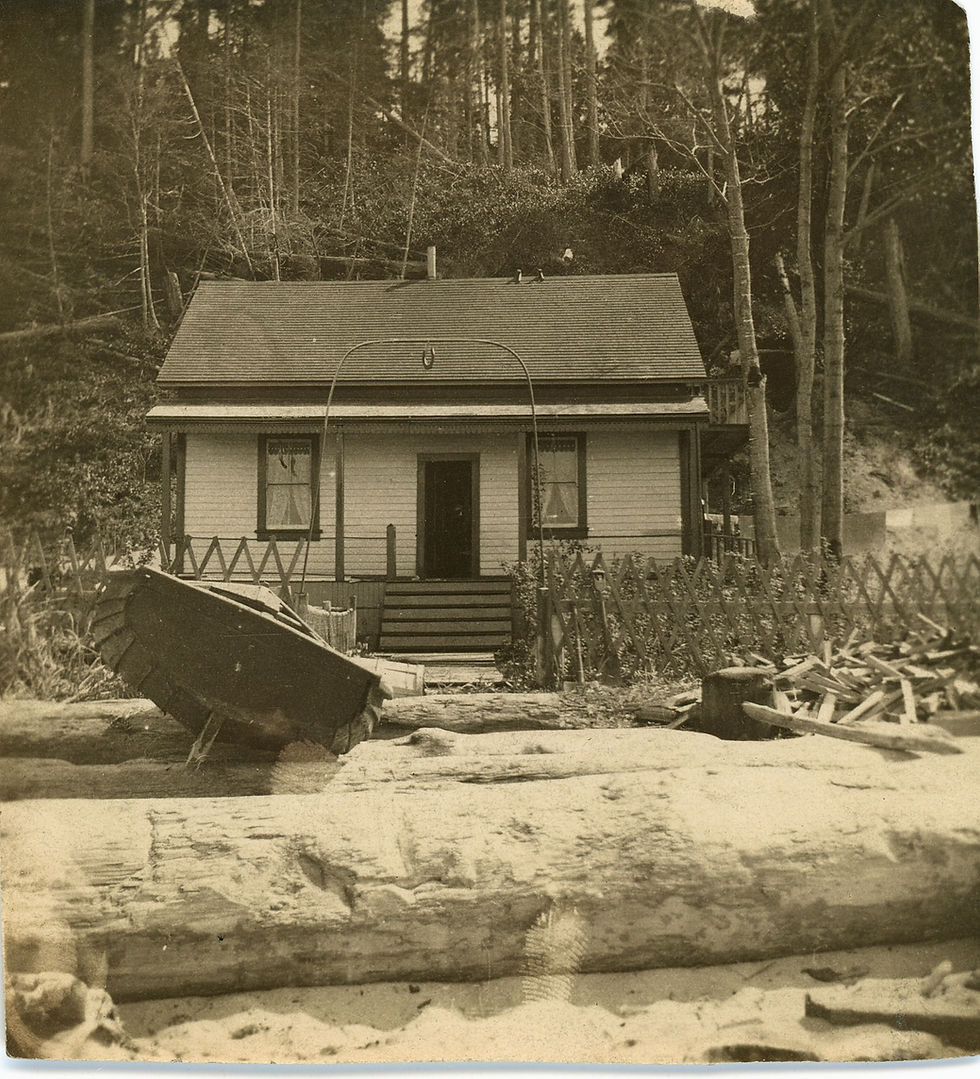
View from the beach dated 1910 with signs of logging visible
In 1910, Jenkins sold the 151 acres to George and Katharine Ashworth. Lewis Anderson moved his family to a similar house he had built, just west of what is now the tennis court.

Photo taken about 1918 showing the new garden and fencing projects. Ashton Spilsbury's tent is in the distance.
George Ashworth was a newspaper reporter who initially came to Savary for a story about the Green murders. He immediately recognized the island's unharnessed potential as a vacation destination.
On May 20, 1917, Ashworth substantially reduced the size of the plot on which the cabin sat. He subdivided the cabin and five acres off from the original 151 acre property. Oddly, this five-acre piece included a narrow waterfront parcel called Parcel B, which starts at mean high tide and extends a number of yards inland. So, the five-acre property included both Parcel A — the inland portion — and Parcel B, the strip along the seaside. Hence, at least the few hundred feet of road in front of the current cabin remains just an easement across private property, and is not a gazetted road.
In 1923, a further subdivision of DL 1373 occurred when Ashworth created acre-sized lots all along the beach, west almost to First Point.
In 1927, the road up the hill behind the cabin was constructed, to connect the Royal Savary Hotel with the wharf.
In 1958, Jim Byrn (wife Joan, children Gordon, Diana and Richard) purchased the five-acre parcel from the estate of George and Katharine Ashworth. Byrn had a long-time connection with Savary, through his grandmother Mary Walkem, one of Savary’s early property owners. He subdivided the five acres into seven lots, six on the waterfront with a larger one behind, and offered them for sale in the spring of 1964.
Sherwood Inglis bought the lot with the original Anderson cabin on it in 1964 for $3,500, and he still owns it in 2026. The cabin was in sad shape, and any other purchaser would likely have demolished it, and started over. But Inglis had a strong boyhood attachment to the cabin, and so spent the following 60 years working to preserve it.

New dormers and roof –– the first step in Sherwood's cabin restoration (1965)
At the same time, Jim Byrn had also floated in two bunkhouses from a logging camp, and skidded them into place on the two lots on either side of the original cabin. The bunkhouses and lots were also offered for sale in 1964, at $9,000 for one and $12,000 for the other.
Finally, the remaining acreage on DL1373 was subdivided into lots, and sold off in the late 1960s/early 1970s, becoming the Savary Shores subdivision.
One positive note concludes this 60 year period of subdivision. A 2 acre parcel and a 15 acre parcel on DL1373 were subsequently acquired by two Savary property owners after environmentally motivated efforts, and these two parcels are now permanently protected in their natural state.

The ivy on the front begins to disappear –– pruning was becoming an unwelcome chore

The ivy has gone - Sherwood on the steps (2022)
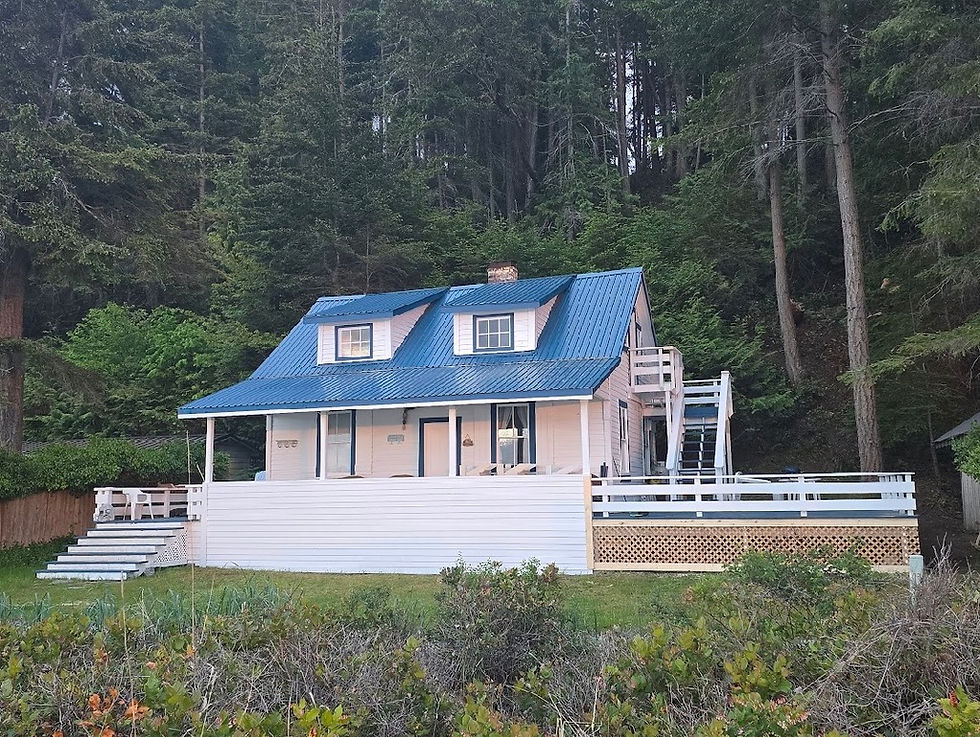
Renovations are nearly completed. New metal roof, new upstairs windows and new deck (2025)
More Notes from Sherwood Inglis
There was no water or plumbing in the cabin in 1964 — the year of purchase. And none was then possible, as the well used in the '40s and '50s was now, after the property subdivision into seven lots, no longer on the lot I purchased.
Harry Keefer told me, and cabin history seems to support him, that the initial source of cabin water was a spring on the hill behind. He and I scrambled around the area searching, but nothing resembling a water source was detected.
So, in 1973, I decided to dig a well.
I brought three pieces of galvanized pipe over on the water taxi — each between 5 and 6 feet long and 30 inches in diameter (I’m sure they thought I was nuts), and commenced digging. At about the 4 foot level, I couldn't get a shovel of sand out of the hole anymore.
A new digging plan was required.
So, I tried putting a ladder down the 4 foot hole, attached a rope to a bucket, climbed into the hole, filled the bucket with sand, climbed back out, and pulled up the loaded bucket. It worked, but it was unhappily slow going. When the hole was about 5 feet deep, I lowered the first of the three pieces of galvanized pipe into it. Gravity kept nudging the pipe down, as I continued digging..
That became the excavation formula followed. Climb down, fill the bucket, climb up, pull up and empty the bucket.
When the hole was 11 or so feet deep, I lowered a second piece of pipe down into the hole, and after more digging, inserted the last piece. That final insertion was certainly a relief, as I was quite concerned about the unsecured well wall collapsing on me as I laboured below.
At 15 feet, water began to fill the hole, and was it ever cold. I would need hip waders to keep going. Fortunately, as it turned out, I didn't need to go further. Next morning, 3 feet of water was in the well, and it has satisfactorily supplied our needs ever since.
The exterior cabin walls, and the walls, floors and ceilings within, were all wood — some of it quite attractive. But, what is impressive is that none of this wood is marred by a knot, let alone a knothole. Testimony perhaps, to the high quality of BC trees available to loggers in the late 1800s, early 1900s.
Over the years since, the cabin has undergone changes and restorations, including the jacking up and levelling of the four initially sagging walls (now on concrete footings). It has undergone three re-roofings, been graced with new dormers, undergone three different stairway designs accessing the upstairs bedrooms, and in 2022, the cabin received a completely new front porch. There are new decks on both the east and west sides, while the kitchen and bathroom have been blessed with, albeit primitive, plumbing and water. The rustic kitchen boasts tidy cabinets now, plus a propane stove and fridge. Finally, the main bedroom embraced the celebrated removal of the most garish and gaudy wallpaper ever designed. (I kept a piece as a souvenir.)
Looking back over these many years, one thing remained consistent. The effort was challenging, but always fun !
Published 2026


