Paradise Lost: Vaughan-Robinson's Savary Island
Updated: May 30
by Ron Thacker
When I was a child in the late 1960s, I remember Dad telling of an island that the family once owned, ‘back in the day'. Then, however, I was far more interested in the sitcom Gilligan’s Island than in talking about some distant relatives, on a distant island, from some distant time. As the years passed, so did those relatives and the stories they held concerning that real estate. Without provenance, that history dissociated into strands of undusted lore and its artifacts, disconnected curiosities.
Decades later, after my grandmother Ruth’s passing, I became curator of some of those items. Most were old postcards and photographs of people and places I had never known. Three cards, however, had been posted between relatives to and from Savary Island, British Columbia, in the 1930s and 1940s. Assuredly—this must be that isle of faded recollection! Excitedly, I rushed these treasures to my father Raymond, who affirmed this designation. He also gave context to those unprovenanced and unannotated images—silent witnesses to another era—identifying himself and others, at an ocean-view cottage on the island.
The heirlooms reawakened our respective childhood memories. Significantly, they were tangible evidence of a familial connection to the island. Eagerly I asked Dad to revisit his memories and the family tradition regarding Savary, which lies 144 km north of Vancouver, in the Salish Sea. He painted warm verbal vignettes of idyllic childhood summers spent during the 1940s on that unbounded playground oasis—raft‑building on South Beach, treasure hunting at Green’s Point, watching ships slip into the night from the cottage’s glass‑enclosed front room—endless beachcombing and, it seemed, endless summers…
But those summers did end for my Dad and for the family. Lamentably, Dad related that this paradise was lost—some whispered stolen—decades ago. He intoned this tatter of tradition, but remembered little beyond his elders’ lingering bitterness over the loss. Purportedly, the loss had been substantial. He then recalled that his great‑aunt, Hannah Detweiler, and “another woman” had owned much of the island—though not that entire isle of imperfect reminiscence. Intrigued by the potency of his story, I resolved to reconcile memory with history.
Savary Island Real Estate
Millennia before our family purportedly owned much of Savary—a concept born of colonial
real estate—the ancestors of the Tla’amin First Nation had long frequented this place, known to them as Ayhus (double-headed serpent). Their connection to the isle was one of stewardship and seasonal return, not possession—a rhythm of gathering and renewal that predated the very idea of property. Then on July 2, 1792, the Tla’amin encountered crew members of British explorer Captain George Vancouver, who had recently de-camped from the north-eastern shore of his newly christened Savary's Island..Thus began the slow transfiguration from stewardship into ownership, from the unbounded wilds of Ayhus into dissected cadastral lines—paradise anatomized for tender.
That process quickened in the 1870s, when the new province’s land commissioners inscribed Savary’s dissection into five District Lots (DL), a prelude to parceling into possession, real estate to attract non-Indigenous homesteaders. That first homesteader came in 1886: John Green, a squatter. He erected a log cabin, store and trading post along Savary’s north-eastern shore, near the very headland that would later bear his name. Then, between 1888 and 1891, Green pre-empted three District Lots—formalizing his claim of ownership of DL 1372 (east Savary), 1375 (mid-island) and 1377 (Indian Point), with official Crown grants being awarded in December 1892.
Green was in the process of pre-empting DL 1373 when he was murdered on October 27, 1893. Dying intestate and without heirs, his properties were sold by an official administrator between 1906-1909. In 1909, these parcels and the rest of Savary were purchased by Minnesotan timber titan/land developer, Harry Leroy Jenkins. Jenkins had come to British Columbia in search of stands to feed an insatiable lumber market. His harvesting, however, exposed Savary to a new extractive ambition: land development.

Picture 1 — Savary Island Sketch Map — inspired by the Vancouver Trust Company’s original advertisement of 2 April 1910, showing District Lot (DL) divisions and the SS Cowichan heading into Lund Harbour.
The Savary Island Park Association
Jenkins mused or was convinced that Savary could be a great resort. In early 1910, he and Mackenzie Urquhart—a Vancouver‑based broker active in coastal real estate syndicates— arranged for the survey of “its choicest parts”: east (DL 1372) and west (DL 1376 and 1377) Savary. Jenkins however, left active speculation to a syndicate of Vancouver developers called the Savary Island Park Association (SIPA). He agreed to sell the speculators most of east Savary, became their financial agent, and, in April 1910, promoted sales through his Vancouver Trust Company.
Then beginning in May 1910, the Savary Island Park Association (SIPA) began organizing promotional excursions to Savary. To entice affluent Vancouverites aboard, the syndicate launched a real estate campaign, advertising timely investment in one of the world’s upcoming great summer resorts—unrivalled in its advantages and certain to quickly appreciate. The excursions reputedly yielded deposits on over fifty lots, grossing around $12,000 in sales.
The Vaughan-Robinsons
Yet SIPA’s exuberance and aspirations were bridled by insufficient capital. To sustain and develop their fledgling enterprise, SIPA sought to “lure the world” of investors to Savary Island. Foremost among these was a Hong Kong businessman, Walter George Vaughan-Robinson, who injected substantial capital into the speculation.
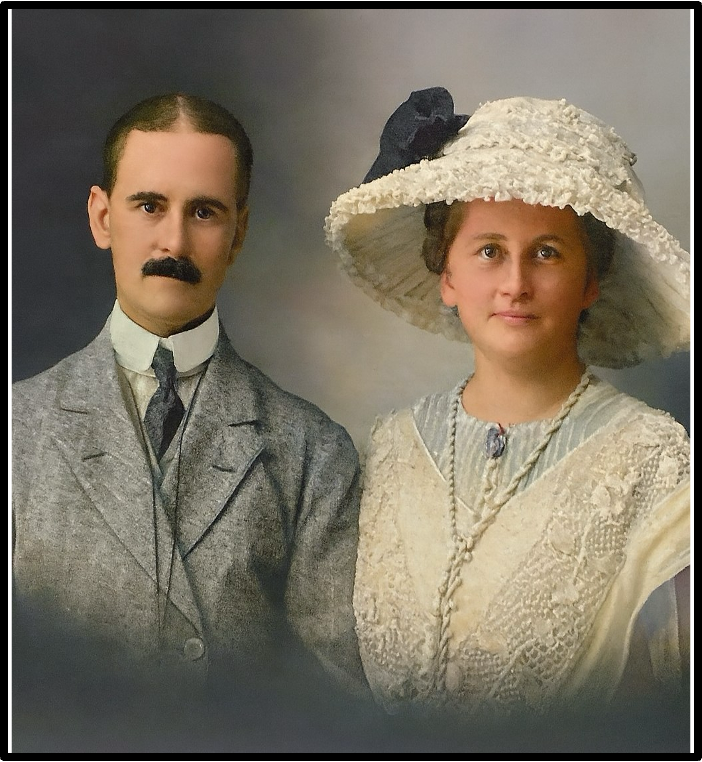
Picture 2 — Formal portrait of Alvilda (Ella) and Walter Vaughan‑Robinson, ca. 1910. A studio portrait capturing Edwardian style, grace, and pre‑war optimism, reflecting the couple’s confidence in the Savary Island Company’s venture and the promise of a new coastal enterprise.
Born in Liverpool in 1860, Walter rose swiftly as an international merchant in the burgeoning trade with China. Living high on Victoria Peak, Hong Kong—the colony’s most exclusive enclave, reserved for governors, taipans, and non-Chinese members of the mercantile elite—Vaughan-Robinson occupied a world of privilege, an ocean away from the speculative venture on a remote wild island outpost off Canada’s northwest coast. The disparity itself invites curiosity: how did a man so distant from British Columbia’s frontier become aware of, and drawn into, such an improbable enterprise? The answer lay not in commerce, but in kinship—a consanguineous thread stretching from the heights of Victoria Peak to the nascent ‘Townsite’ of Powell River, British Columbia.
And so it was—a convergence of geography and family ambition, that drew one James Longmore Detweiler into SIPA’s tidal pull, his own undertow drawing the Vaughan-Robinsons in turn. “Jimmy” lived in Townsite, a mere twenty-five kilometers from Savary Island. He was a shrewd opportunist—part swashbuckler, fight promoter, horse‑race enthusiast, marine engineer and full‑time scoundrel—always chasing the next dollar. It was Jimmy’s appetite for avarice and adventure—whetted by the coastal boom that brought him to Powell River—which compelled him to petition his new wife, Hannah (née Olsen), to write her wealthy cousin ‘Ella’ about the island speculation, likely between early 1910 and the summer of 1911.

Picture 3 — Jimmy Detweiler with Ella and Walter Vaughan‑Robinson, taken shortly after Jimmy’s return from World War 1, ca. April 1919. Their heavy coats mark the lingering cold of early spring, and Jimmy’s presence signals his sustained investment in the Vaughan‑Robinson acquaintance.
‘Ella,’ the Anglicized forename of Norwegian immigrant Alvilda Olivia Olsen (later Johnson), became the consort and, in time, wife of Walter George Vaughan‑Robinson . It was that cousinly correspondence and commercial ambition that stirred the Vaughan‑Robinsons from the Orient to Vancouver on Friday July 21, 1911—a journey that transported them from the refinements of empire to the untamed littoral of Canada’s northwest coast.
From Vancouver, they boarded the northbound Canadian Pacific steamer SS Cowichan. They sailed overnight to the Powell River Company’s Townsite wharf to meet the Detweilers, thence north to Lund. From there, they were spirited across Malaspina Strait by launch to Savary Island. Given Jimmy’s profession as a marine engineer, his reputation as an accomplished seaman, and his restless opportunism, he almost certainly conveyed the party across Malaspina Strait—whether directly from Powell River or by assisting with the transfer from Lund.

Picture 4—Walter and Ella Vaughan-Robinson with great-niece Leona Myrtle Gilbertson, Savary Island, summer 1911— arrival at the tidal edge of enterprise. Nearly a decade later, the Vancouver Daily World on January 18, 1922, reported that “Mr. Vaughan-Robinson…took a fancy to the place when on a visit there.”
It was the Vaughan-Robinsons first trip to Canada, and they would not return for another two years. During the interim, the boundless optimism of British Columbia’s robust economy spurred an irrational exuberance—a speculative real estate fervor. The excitement helped solidify the “gentleman’s agreement” between SIPA and Jenkins in December 1911, when SIPA formally acquired the unsold lots of DL 1372. The exuberance persisted; on March 17, 1914, the Vancouver Daily World commented on those boom years, remarking that the provincial government had become “nothing but a huge real estate agent, subdividing and selling land to speculators”.
As the speculative fervor neared its high-water mark, Vaughan-Robinson sailed into Vancouver and into enterprise. On September 15, 1913, he entered into an agreement with the Savary Island Park Association (SIPA). Under this accord, he purchased the mortgages held by Messrs. Jenkins and Urquhart, from SIPA. This transaction, however, limited SIPA’s aspirations for the Park’s proposed infrastructure. As a remedy, its members agreed to transfer to Vaughan-Robinson, seventy lots selected by him, for a release of $4,000 in agreements of sale. All income derived from the sales of SIPA-held lots was to be applied to the mortgage indebtedness. It was a working agreement—part written, part gentleman’s. Effectively, Vaughan-Robinson gained concessions that made him “co-adventurer and partner in the enterprise”—or so thought SIPA. Like the pre-war optimism and economy in British Columbia, their agreement was to deteriorate precipitously.

Picture 5 — August 1913 — Front Row lots, DL 1372, North Beach, Savary Island Part of the Savary Island Park Association agreement with Walter Vaughan‑Robinson; several of his seventy concession lots lay here. Harry Keefer’s cottage stood west of the future wharf, in the first bay west of Green’s Point, directly before the sailboat manned by his son Herbert .
In autumn 1913, the sudden collapse of the world lumber market seized the construction and real estate powertrain that had been driving the British Columbian economy. This financial catastrophe lasted into late 1915, though its memory was ephemeral. Mackenzie Urquhart and George Ashworth—who later partnered in financing the Savary Island Company—would cite the war as pre-empting lot sales; in truth, it was the implosion of the real estate bubble that decimated the market and the provincial economy. By February 1914, the Vancouver Daily World advised against “anyone from the east to come to British Columbia or Vancouver for a number of years unless he is worth a bunch of coins and willing to spend some of it". Vaughan-Robinson came, he saw, he invested…and his timing could not have been worse.
Vancouver’s real estate bubble soon burst, and the effects rippled up the coast. SIPA teetered briefly on the edge. Overextended and overdue on seven agreements prior to its covenant with Vaughan-Robinson, the association grasped his financial lifeline. Yet, shackled to the deepening economic crisis, SIPA’s fortunes sank into insolvency in 1914. Now instead of savoury profits, Vaughan-Robinson held devalued Savary property. He then demanded that members resume possession of their respective mortgages, pressed for delinquent payments, and refused to issue deeds; Savary Park foundered.
At the other end of the island, George Ashworth—with wife Katharine as selling agent— tried to keep the Savary Island Company buoyant, securing a $20,000 mortgage from the Vancouver Trust Company. Yet it was little more than rearranging the deck chairs on the Titanic, as Vancouver Trust threatened foreclosure in separate litigations against Urquhart and the Ashworths over their Savary obligations. Similarly, SIPA members and their wives who held Savary mortgages sought the debt-protective provisions of the War Relief and Land Registry Acts.
Vaughan-Robinson vs SIPA
In 1919, Walter Vaughan-Robinson filed suit against twenty-two mortgagors in the Supreme Court of British Columbia. In the Judgement Order of January 13, 1920, the only defendant eligible for the aforecited debt relief was Great War veteran Malcolm McCraith. Continuing litigation forced Savary off the market in 1923.
The case, long mired in paperwork and recrimination, finally reached the bench on January 22, 1922. Over four days of proceedings, Mr. Justice MacDonald endeavoured to disentangle the complicated and unsavoury 1913 arrangement. While recognizing Vaughan-Robinson’s claim for the capital advanced to SIPA, His Lordship allowed SIPA’s counter-claim to offset a portion of it. He directed that the deeds be issued to all agreement holders completing their payments and that clear title should be forthcoming in future sales by SIPA. In closing, Mr. Justice MacDonald advised the parties “to work together harmoniously in the future on the principle of give and take".
With the 1922 accord, Vaughan-Robinson acquired all unsold lots as shown in the 1923 tax record; he then owned 283 of 360 lots within Savary Park. Over the next fourteen years, his holdings fluctuated as he sold, traded or repurchased properties. During this period, it is unknown whether the Vaughan-Robinsons visited Savary, though family members continued to vacation there, staying at times at the Savary Inn, Kingarth, and perhaps other island abodes.
By 1930-1932, his holdings reached their maximum extent within the Park Association: 287 lots—about 80 percent of Savary Park’s total. Indeed, Vaughan-Robinson owned most of the developed end of the island, this in counterpoint to the hotel and eight houses at Indian Point, which evidenced the recently incorporated (1927) Savary Island Company’s ill-fated resuscitation of the Savary Park dream.
The dream was over, as were the lawsuits, yet Savary continued to be a source of consternation for Vaughan-Robinson. Lot valuations—always contentious—plummeted during the Great Depression. With increasing age, infirmity and abated interest, Walter became anxious to expedite sales, at times tendering significantly discounted prices. When he died in 1936, among nearly $200,000 in assets were 196 lots on Savary Island. His widow was to inherit those properties in June; soon thereafter, Ella began receiving sale enquiries.
The Vaughan-Robinson House
Then, in late 1937 or early 1938, Canadian film and television director Daryl Duke, related how “his forest was one day suddenly disturbed” by the construction of “the white house”, built adjacent to his family’s canary yellow cottage. Ella had contracted William Mace to draw up the blueprints and oversee the construction of a home on Lot 21, Block 2 (DL 1372). The Vaughan‑Robinson home—with its basement well and reputedly the island’s only oil furnace—marked a rare gesture toward a more enduring settlement on a largely seasonal shore.

Picture 6—Bill Mace and Ella Vaughan-Robinson, ca. spring 1938 Bill Mace drew up the blueprints and constructed her North Beach home—finishing touches
These modern conveniences bespoke Ella’s gentle petition to Hannah—that she would find in the home both occupation and solace during Ella’s absence, as she habitually wintered at her villa in Monte Carlo, Monaco. Hannah had been living in California since 1922, and likely returned north in the later half of 1936. That migration was prompted less by Ella’s design than by fate.
In March 1936, husband Jimmy was arrested in the United States for his role in a million dollar alcohol-running conspiracy. Following his escape back to British Columbia, Hannah found herself once again estranged and adrift—heading north once more; their marriage measured in long departures and brief, fleeting returns to port. The Vaughan-Robinson home became her beacon—offering stability, purpose and refuge, a logical appointment for a woman whose life had been defined by absence and the sea’s unforgiving pull—almost providential.

Picture 7 — Ella Vaughan‑Robinson’s Cottage, North Beach, Savary Island, BC ca.1938
A West Coast Arts‑and‑Crafts vernacular dwelling, its diamond‑pane bay windows faced North Beach and across Malaspina Strait toward the blue-grey ramparts of the Coast Range.
Ella and Hannah eventually returned to Savary in the spring of 1938. Within months, Vaughan-Robinson had christened her newly constructed home by hosting a large family reunion. That inaugural summer unfolded in full celebratory pageant—the island was alive with family, laughter, lanterns, and the rekindling of bonds long separated by distance. Some of the family stayed in Ella’s house, others in canvas tents or in nearby lodgings such as Kingarth and the Savary Inn. It was a grand gathering, showcasing the island, the new summer home, and its properties. There was even a masquerade ball, for which nephew Robert Parker was charged with mooring the incoming boats of guests. Their postcards exalted that “Savary is a dream (and that) it was wonderful to see you all again!”

Picture 8 — Spilsbury and Vaughan‑Robinson relatives pause between the mainland and Savary Island, at Jim Spilsbury’s radio‑service dock, Lund Harbour, summer 1938 or 1939.
Ella Vaughan-Robinson stayed on Savary until mid-October, then departed for her villa in Monte Carlo. She returned in May 1939, and soon received a renewed petition to sell two lots behind the tennis court. In her reply, Ella declined, noting that “...since inheriting the Savary property, I have had no revenue from it and there has been some expenses…and I (have) been unable to make a survey of the lots I own and must do this before making any future plans”.
Those plans, however, were soon pre‑empted by the storm brewing in Europe. Ella once again retreated to Monaco, her fragile refuge, as the continent darkened under the Axis shadow. By then, the Canadian government had requisitioned Jimmy’s lightning-fast San Tomas for war service, patrolling the vulnerable West Coast. Ever the restless seadog—and guided by his own moral compass—Jimmy negotiated her service on the condition of his command. He then enlisted in the Royal Canadian Navy Volunteer Reserve (RCNVR), where duty and desire found common course, and his mastery of coastal waters found rightful sanction.
And, as for Hannah, she lived alone in the house for the duration of the war, save for summer visitors. Ella, who had left Savary for Monaco, soon found herself under Axis occupation and declining health; she never returned. Even Jimmy, who had listed Savary as his residence on his attestation form, is doubted—-and consistent with the reflections of long-time residents—to have ever lived on Savary with Hannah…the sea being his constant mistress—and only true home.
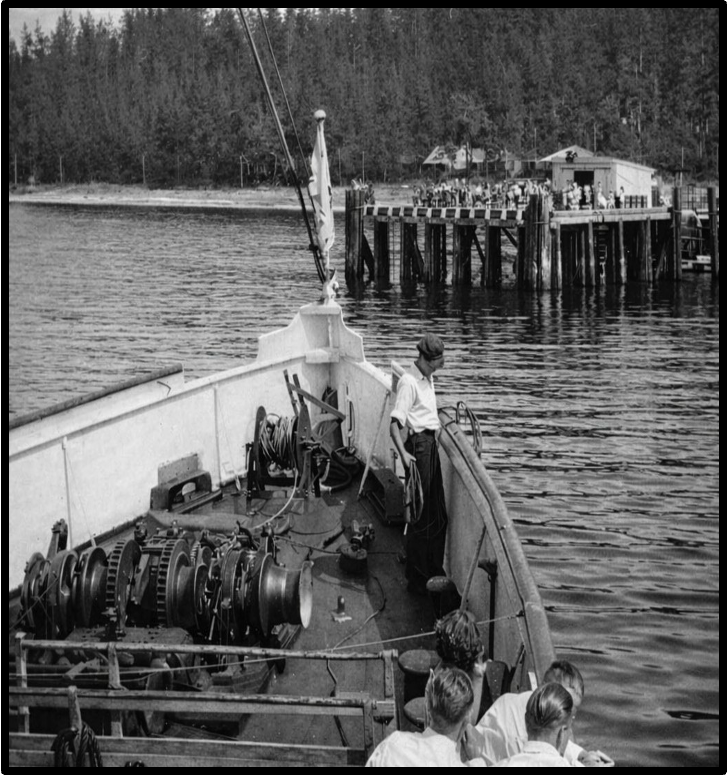
Picture 9—The Union Steamship Company’s Capilano (2) summer 1941— Cutting across Malaspina Strait toward Savary’s north-shore wharf, she carried our family from workaday shores to the island’s quiet expectancy.
A Legacy Abated
During the war years, Savary became Hannah’s vigil: the house her charge, isolation her companion, solitude her inheritance. With Ella’s death on August 18, 1946, those conditions became irrevocable, sealed by loss and time. Her material legacy followed: among the $176,000 in assets were 158 lots and a one-fifth interest in an additional lot on Savary Island. Ella bequeathed that her brother Oscar Johnson and cousin Hannah Detweiler were to share undivided interest in those properties. By September 1946, however, Oscar had died, and his daughter Ella Phillips inherited his share. The heirs were also to receive twenty percent of the residue of Ella’s estate in Monte Carlo ($31,716.53). Their windfall, however, faced turbulence.
Despite having substantial assets in Europe, Ella Vaughan-Robinson’s smaller estate in British Columbia faced significant debts and liabilities. Unfortunately, these debts could not be discharged, as the estate had insufficient assets in BC banks and personal property (not land), that could be liquidated into cash. Ella Vaughan-Robinson’s Savary holdings were to be sold until the provincial debt was satisfied, effectively abating her Savary legacy before the residue could be inherited.
In fulfillment of this order, the estate’s administrator, Clarence Darling, began selling off lots in the autumn of 1947. Hannah continued to live in the house—and the family still visited—even as the estate diminished around her. She had hoped that enough lots could be sold to satisfy the debt and allow her to retain the house. However, sales in the depressed real estate market were slow; many lots remained unsold by 1950. This lack of liquidity persisted, and thus liabilities and legacies remained unsatisfied.

Picture 10 — Hannah Detweiler and Jennie Parker’s family. North Beach, Savary Island, ca. summer 1944. Sisters reunited on the sand — Hannah (second from right) and Jennie (far right) — with some of Jennie’s children and grandson Raymond Thacker; a wartime summer briefly unbroken by distance.
Paradise Lost
The act of probate proved taxing on the co-heirs. By the summer of 1950, they resigned themselves to dispose of the Vaughan-Robinson house—furniture, and all remaining lots. At this juncture, the elderly and ailing Hannah abandoned Savary, returning to reside with her sister Jennie in Port Moody—never to return.
On June 8, 1951, the BC Supreme Court ordered that Ella Vaughan-Robinson’s provincial debts be paid from her Savary Island holdings, an amount of $14,791.54. On August 21, 1951, the Vaughan-Robinson home, furniture and three contiguous lots were sold to John and Elizabeth Crane for $5,750. By January 1953, enough real estate was sold to satisfy Ella’s BC debts and liabilities. Hannah’s Savary inheritance was reduced to a half-interest in 104 lots and one-fifth share in another—most were interior parcels, though thirty-nine were along Oceanview Esplanade overlooking beautiful South Beach. So, despite attrition through probate, Hannah inherited prime Savary real estate—land on which to build or preserve a family heritage.
Yet that inheritance rested on shifting ground. Beyond probate lay a confluence of forces that eroded any vestige of interest that Hannah—or any relatives—may have held in those remaining properties. The end of regular passenger service to Savary by the Union Steamship Company in 1950 and the Gulf Steamship Line in 1951 significantly diminished the number of summer sojourns to the island. Their replacement, the sinuous, day-long drive and Black Ball motor-vessel service that punched up the Sunshine Coast to Lund in late 1954, was markedly less attractive to the less adventurous, more senior family members. But, most significantly, the Vaughan-Robinson cottage—hearth and forge of years of family memories—was no longer ours; strangers would kindle their own fires there.
It was a period of transition for Savary. Old islanders departed as new faces washed ashore; memories left, faded or ceased—new stories took their place. Beginning in the late 1940s, British Columbia’s island vacation destinations increasingly yielded to the age of motoring holidays and flights to the real South Seas. Demand for island cottages and lots diminished; real estate prices plummeted. Reputedly, some of Hannah’s inside lots sold for a nominal five dollars—scarcely more than a gesture of transfer. Some family members thought her naïve, others manipulated, but the more plausible reason was both insidious and organic: Hannah was suffering from dementia.
After her death in October 1958, Hannah’s Savary interests were left to her sister Jennie Parker, my great-grandmother. Unfortunately, Jennie also inherited a legacy of delinquent taxes. Certainly, as time and dementia advanced, Hannah had been unable to manage her own financial affairs. So, despite having considerable assets from which to have paid her Savary property taxes, these accrued unchecked, for years. Those taxes amounted to only $72, but the heirs chose to relinquish their interests in Savary, rather than retain them. By the autumn of 1961, Jennie Parker and Ella Phillips forfeited those properties to the Crown. All were sold by auction, some for a mere pittance. My family’s once-upon-a-paradise, later abated, was now lost.
One of my earliest recollections of family lore is that we once owned an island. Decades later, this recovered history confirmed that the Vaughan-Robinson home on eastern Savary Island was indeed part of a much larger reality. Legacies pass on….
In 1984, the Cranes sold the Vaughan-Robinson home and adjacent lots to Daryl Duke, great-nephew of SIPA member R.S Sherman. Poignantly, the house and property passed to the relatives of Sherman—the only man alleged to have satisfied his debt to Vaughan-Robinson. In 2012, Daryl’s widow Anne-Marie graciously welcomed my daughter Destiny and me into her Savary home, where I shared this story—a story that resurrected our family’s connection to the island’s history, not only for posterity, but to a lost generation of our own family, who now return to its magnetic shores each year, drawn by history and memory’s tide.
Published 2026

